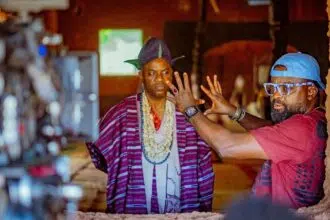







Kunle Afolayan has built a reputation for crafting stories that pull viewers deep into Yoruba folklore and ancient Nigerian settings. His 2022 film Anikulapo did just that; it told the tale of Saro, a wandering weaver whose ambition and forbidden love led him to a mystical encounter with death itself. The movie struck a chord with audiences worldwide when it landed on Netflix, blending drama, fantasy, and cultural details in a way that felt fresh yet rooted in tradition. Now, after turning that story into a six-episode series called Anikulapo: Rise of the Spectre in 2024, Afolayan is bringing fans a second season set to drop on January 30, 2026.
Saro Takes His Trouble to Ghana
The announcement came straight from the director himself in early January 2026 via Instagram, where he shared a photo from the first season and captioned it with excitement about the upcoming release on Netflix. Fans have been waiting for this news since production wrapped up months earlier. Reports from outlets like Premium Times Nigeria and Legit.ng confirmed the date, noting that filming took place not just in Nigeria but also in Cape Coast, Ghana. This move marks a significant step, expanding the narrative beyond the familiar grounds of the Oyo Empire.
To understand the hype around season two, it helps to look back at where the story left off. The original Anikulapo film introduced Saro, played by Kunle Remi, as a talented cloth weaver who arrives in Oyo seeking better opportunities. He catches the eye of one of the Alaafin’s queens, Arolake, portrayed by Bimbo Ademoye, and their affair spirals into tragedy. Beaten to death for his indiscretion, Saro meets Akala, a mystical bird that revives him, granting him the power to cheat death through a special gourd. He takes the name Anikulapo, meaning “one who holds death in his pouch.” But pride gets the better of him; he refuses to resurrect Arolake after she sacrifices everything for him, leading to her permanent death and his own downfall.
The film ended on a note that screamed for more, with Saro facing consequences in the afterlife. That thread picked up in Anikulapo: Rise of the Spectre, the first season of the series that premiered on Netflix on March 1, 2024. Here, Saro finds himself back in the realm of the dead, bargaining for another chance at life. To return to the living world, he must complete a daunting task: reclaim the souls of the twenty people he previously brought back from death. Armed with an amulet, he heads to the village of Ojumo, where new challenges await, including falling for a palm wine tapper’s daughter.
The series expanded the world considerably. Veterans like Sola Sobowale returned in powerful roles, joined by actors such as Taiwo Hassan, Lateef Adedimeji, and Owobo Ogunde, whose portrayal of Bashorun stole many scenes. Critics and viewers praised the visuals; the production was shot entirely at Kunle Afolayan’s own KAP Film Village in Igbojaye, Oyo State, recreating an authentic ancient Yoruba setting with markets, palaces, and rituals that felt alive. The costumes, makeup, and set design drew particular acclaim for immersing audiences in pre-colonial life.

Yet the first season received mixed feedback. Some hailed it as a step up from the film, appreciating how it seamlessly continued Saro’s journey while adding layers of philosophy about life, death, and power. The interplay between Saro and spectral figures brought tension, and subplots involving palace intrigue kept things moving. Others felt it introduced too many new characters and side stories, making the pace drag at times. Reviews on platforms like IMDb and Rotten Tomatoes noted the strong cinematography but pointed out occasional confusion from overcrowded plots. One common sentiment was that the series shone brightest when focusing on core themes of ambition and consequence, much like the original movie.
Despite those critiques, Rise of the Spectre performed well on Netflix, often trending globally and sparking conversations about African storytelling on international platforms. It built on the film’s success, which had already won awards at the Africa Magic Viewers’ Choice Awards, including Best Overall Movie. Afolayan’s attention to cultural accuracy — from Yoruba proverbs to traditional attire — helped the project stand out in a crowded streaming landscape.

Filming in Ghana came about through a partnership with the country’s National Film Authority under their “Shoot in Ghana” initiative. Launched to boost the local industry, the program encourages international productions to use Ghana’s landscapes, facilities, and talent. Afolayan first scouted locations there in 2024, and principal photography followed, involving Ghanaian actors like Fella Makafui, who plays a character named Abena and even learned Yoruba lines for authenticity.
This collaboration highlights growing ties between Nollywood and Ghana’s film scene, often called Ghallywood. Afolayan has spoken about breaking down borders, noting how the two nations share cultural overlaps that enrich joint projects. The National Film Authority’s CEO, Juliet Asante, emphasized skills transfer, with Afolayan’s KAP Academy providing training to local crew members. Over 200 Ghanaian talents participated, creating jobs and fostering exchange.
The cast for season two mixes returning favorites with fresh faces. Sola Sobowale, Kunle Remi, Bimbo Ademoye, Oyindamola Sanni, Aisha Lawal, Moji Afolayan, Eyiyemi Afolayan, Ronke Oshodi-Oke, Taiwo Hassan, and Lateef Adedimeji are back. New additions include Bukunmi Adeaga-Ilori (KieKie), Antar Laniyan, Joke Muyiwa, Saidi Balogun, and others, plus international actors from Portugal to reflect the slave trade’s global reach.
Details on the exact plot remain guarded, but Afolayan has hinted at continuing Saro’s arc while exploring rescue attempts and broader historical connections. One thread mentioned involves a character trying to save a sibling from European merchants, tying into the era’s harsh realities. This thematic expansion could address criticisms of the first season by grounding new subplots in meaningful history.
Afolayan’s approach has always prioritized authenticity. He built his own film village for consistent settings, and moving to Ghana ensures the same for these new chapters. Sources like The Nation Newspaper and THISDAYLIVE quote him saying filming in Oyo State and Ghana roots the story in real heritage sites, making the narrative more compelling.

As January 30 approaches, anticipation builds. The first season proved African epics can thrive on global platforms, and this sequel’s cross-border production signals ambition. By tackling sensitive history with a diverse cast and real locations, Afolayan aims to educate as well as entertain. Whether it smooths out the pacing issues from season one or dives deeper into folklore remains to be seen, but the foundation is solid.
For fans of the original film and series, this return feels like a natural evolution. Saro’s journey from greedy resurrector to spectral messenger now ventures into uncharted waters, literally and figuratively. With Netflix’s reach, millions will witness this blend of myth and history. Kunle Afolayan continues to push boundaries, proving that stories from this part of the world deserve epic scale.
The wait is almost over. On January 30, 2026, Anikulapo rises again.