







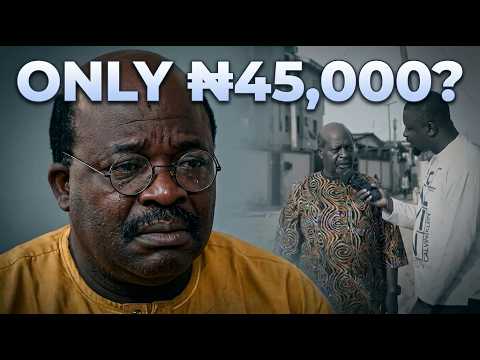
Nollywood pulls in billions at the box office. Its veterans scrape by on scraps. That contradiction hits hardest with Papa Ajasco. The man who defined a generation of comedy now earns 45,000 naira per episode on the very show that built his name. This is not hype or exaggeration. It is the documented reality that exposes how the industry cashes in while its founders get left behind.
The numbers tell a clear story first. Funke Akindele’s film Behind The Scenes crossed 2.76 billion naira in gross box office receipts. It became the first Nollywood title to smash the two billion mark and set a new record for the highest earning African production in cinemas. Toyin Abraham followed suit with her directorial debut OverSabi Aunty. That one cleared one billion naira at the tills and earned her an official honor from the National Film and Video Censors Board. West African cinemas as a whole pulled 15.6 billion naira in 2025 with Nollywood claiming nearly half the share. These figures prove the market has exploded. Producers, distributors and new stars pocket serious money from ticket sales alone. Yet the veterans who laid the foundation see none of it trickle their way.
Papa Ajasco stands as the clearest case study. His real name is Abiodun Ayoyinka. He is 65 years old and has carried the lead role in Wale Adenuga Productions’ long running series since the late 1990s. In a March 2026 interview with Lucky Udu that spread across social media and news sites, he laid out the pay structure without any spin. Back in 1997 he received 22,500 naira per episode. Nearly thirty years later the fee has climbed to 45,000 naira. He pointed out he owns neither a house nor a car. The production shoots only a handful of episodes each year sometimes twelve at most. That works out to roughly 540,000 naira annually before any other costs. Legit.ng reported the exact quotes from the conversation and framed it as a veteran opening up about persistent financial pressure despite decades of fame.
The article stands as the primary reputable source because it quotes Ayoyinka directly rather than second hand gossip. Wale Adenuga pushed back hard. The producer called the broke narrative misleading and said Ayoyinka had opportunities outside the franchise if he followed approval rules for the trademarked character. That response appeared in Punch and Vanguard within days. It highlights one specific failure in the system. Even when a veteran speaks out the producer frames it as personal mismanagement instead of addressing the flat fee model that never scaled with industry growth. Ayoyinka still cannot leverage the Papa Ajasco brand for side deals without clearance. The character belongs to the company. That ownership clause locks him into the same low rate while the show keeps airing and generating value elsewhere. The veteran problem stretches beyond one actor. Dejumo Lewis made the same point years earlier.
In a 2015 Punch interview the Village Headmaster star admitted he struggled to pay rent and staff salaries. He described himself as one of the poorest paid legends in the business despite the icon label. Debt piled up and loyalty from his team only masked the gap. Fadeyi Oloro took it further in 2021. The Yoruba screen veteran posted a tearful video begging Nigerians for medical help. He said colleagues had not reached out and basic survival had become a daily fight. More recently Sunday Olaoluwa Afolabi appeared in a danfo bus driving passengers in Lagos. Fans spotted him in early 2026 and linked it to ongoing struggles after his wife’s death. These three cases share one thread. Each man built decades of screen time that helped Nollywood grow into a cultural force. None received backend payments or scaled compensation when the money started flowing bigger.
The pattern repeats because the payment structure never evolved. Early Nollywood ran on straight video sales and episodic TV deals. Producers paid a one time fee per project or per episode. No residuals kicked in when tapes got pirated or shows reran on cable. That model worked when the whole industry operated on shoestring budgets. It fails now that cinema tickets and streaming deals hit nine figures. New directors like Akindele and Abraham negotiate profit shares or backend points because they control the projects.
Veterans signed old contracts that cap their cut at the day rate. Shoots for long running series happen infrequently. Twelve episodes a year at 45,000 naira leaves gaps that force actors to chase unrelated gigs or stay silent. Piracy still eats into any secondary revenue that might have existed. Streaming platforms pay licensing fees to producers not to the cast. The result is simple. Billions move through the system. Veterans stay stuck at 1990s level compensation adjusted for inflation that never kept pace.
Consider the broader economics. Nollywood shifted from VHS cassettes in the 1990s to big screen blockbusters today. Papa Ajasco and Company launched in that VHS era when a few thousand naira per episode felt decent. Inflation and naira devaluation changed everything. Nigeria’s current minimum wage sits at 70,000 naira monthly in many states. Ayoyinka’s annual take from the show barely clears that on a good year.
Meanwhile cinema operators split ticket revenue with distributors who then pay producers. The top slice goes to marketing and prints. What remains rarely flows back to the original cast unless they negotiated points upfront. Young stars demand and get those points. Veterans do not because their leverage vanished once the character became the brand. The specific failure here is contractual rigidity. Producers treat the actor as interchangeable labor instead of equity partners in the intellectual property they helped create.
Other industries handle veteran welfare with built in safeguards that Nollywood lacks. Hollywood uses the SAG-AFTRA union to enforce residuals. Actors earn extra every time a film or show streams or airs in syndication. Producers pay 20 percent more on top of wages into pension and health funds. After ten pension credits a performer qualifies for monthly retirement checks that start at age 65. The system guarantees income long after the initial shoot ends. It does not rely on goodwill or viral pleas. Nollywood has no equivalent union power or mandatory backend. That gap explains why veterans beg online while box office charts celebrate billions.
The cultural cost runs deeper than bank balances. Papa Ajasco shaped Nigerian humor for an entire generation. Families gathered around television sets to watch his antics. The character became shorthand for everyday absurdity in Lagos life. That reach built the audience that now fills cinemas for Akindele’s films. Without those early stars the market never expands. Yet the industry rewards the current crop and treats the pioneers as relics. Ayoyinka’s interview sparked donations and debate. Some fans sent money. Others questioned why a 30 year veteran still pleads for basics. The donations highlight public sympathy. They do not fix the structural flaw. One off gifts cannot replace steady scaled pay.
Skepticism matters here. Not every veteran story reflects pure industry failure. Personal spending choices play a role in some cases. Health issues or family obligations drain savings for others. Still the data lines up too consistently to dismiss as individual bad luck. Multiple actors from different eras describe the same flat fee trap. Lewis in 2015. Oloro in 2021. Ayoyinka in 2026. Each case cites decades of work with no asset building. Meanwhile producers release statements defending the status quo. The defense always circles back to the same point. The actor signed the deal and the company owns the rights. That legal stance ignores how power tilted when the money scaled up. Veterans signed when options were few. Producers now hold all the cards.
Nollywood’s growth story looks impressive on paper. Fifteen point six billion naira across West African screens in one year. Record breakers like Behind The Scenes proving local stories sell. Yet the veteran angle reveals the uneven split. The billions reward those who control distribution and marketing. The actors who delivered the performances that made audiences show up receive fixed scraps. Papa Ajasco’s situation forces the question into the open. If the industry cannot support the man whose face defined its early success then the boom benefits only a narrow slice at the top. Real change would start with backend clauses in every contract and a collective fund for long serving performers. Until that happens the pattern will continue. New hits will break records. Older faces will keep explaining why they have no house or car after thirty years on screen. The evidence sits in the pay stubs and the box office charts. They do not match.