





The 12th Africa Magic Viewers’ Choice Awards held on Saturday, May 9, 2026 at the Eko Hotel and Suites in Lagos, Nigeria, and by the time the night was over, one film had completely rewritten the story of the evening.
Let’s be honest. Nobody expected it to go down like this.
The atmosphere inside the venue changed the moment the final categories started rolling in. What had begun as a glamorous night filled with polished speeches, designer outfits, celebrity reunions, and predictable applause suddenly turned into something far more electric.
By the time the ceremony closed, the emotionally raw drama had claimed the night’s most prized honours, including Best Movie, Best Director, and Best Lead Actor for Uzor Arukwe, defeating heavily financed productions that arrived with all the commercial muscle, streaming numbers, and marketing firepower the industry could muster. It was not a quiet upset. It was a full-throated statement.
Arukwe’s Moment, Years in the Making
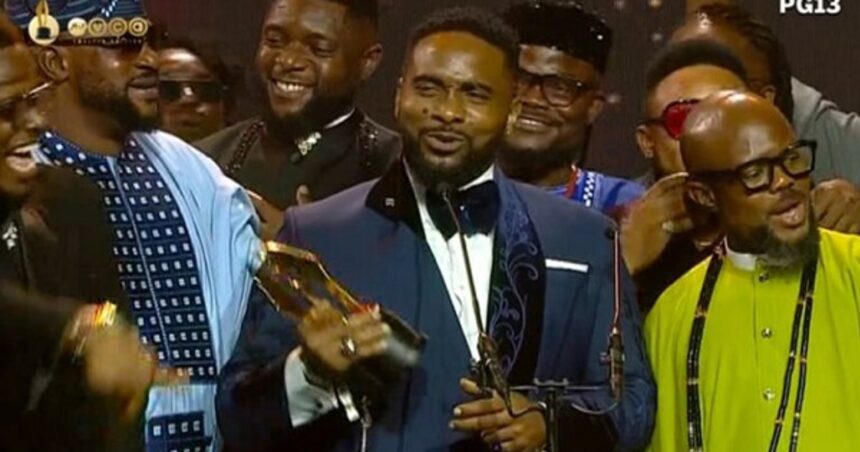
When Uzor Arukwe’s name was called for Best Lead Actor, the room did not politely applaud. It erupted. Fellow actors were on their feet before he reached the microphone. Colleagues who have watched him grind through this industry, navigating inconsistent opportunities, industry politics, and the relentless pressure to stay visible, looked genuinely moved. Some could barely keep it together.
His acceptance speech matched the moment perfectly. No manufactured emotion. No viral-bait theatrics. He spoke about discipline, patience, and the invisible battles actors fight long before any audience sees the finished film. He dedicated the award to young Nigerian performers still trying to find their footing in an industry that too often rewards visibility over actual craft.
It landed because it was true.
On screen, Arukwe’s performance in My Father’s Shadow never begged for attention. That was precisely the point. Where other performances in this year’s race leaned into grand dramatic gestures, Arukwe built his character from the inside out, through restraint, through silence, through the kind of micro-expressions that demand an audience lean in rather than sit back. His was a performance that trusted viewers to be intelligent. Remarkably, they were.
A Film That Refused to Shrink
My Father’s Shadow entered awards season without the infrastructure that typically powers a sweep. No breakout streaming numbers. No international premiere buzz. No celebrity-endorsed marketing campaign. What it had was a script that treated its audience like adults, a director who understood that vulnerability is not a weakness, and a cast committed to emotional precision over spectacle.
The film’s screenplay explored fatherhood, memory, resentment, and the complicated inheritance of pain without flattening any of it into heroes and villains. Every character was flawed, recognisable, and carrying history. The direction gave scenes room to breathe. Conversations unfolded the way they actually do, messily, incompletely, truthfully. The cinematography, despite working without a blockbuster budget, never once called attention to itself. It quietly served the story, which is the highest compliment you can pay a camera operator.
When Best Director was announced in favour of My Father’s Shadow, the room shifted. When Best Movie followed, the room broke open.
The Debate This Result Reignites
Nollywood has been having a quiet identity crisis for several years now. As the industry expands globally through streaming deals, international co-productions, and improving technical standards, a certain pressure has crept in. The pressure to look expensive. To feel international. To compete with foreign blockbuster structures on their own terms rather than on Nigeria’s.
Critics have been warning about it. The craft of storytelling, the specific, culturally rooted emotional honesty that made Nollywood’s voice distinct, was at risk of being traded for glossier aesthetics and crossover appeal.
My Father’s Shadow walked directly into that conversation and made the loudest argument possible for the other side.
Its success does not mean budgets do not matter, or that technical ambition is a waste. It means that without emotional truth at the centre, all of that ambition is decoration. Audiences can tell the difference. Apparently, so can the voters.
What Happens Next
Social media caught fire before the after-parties even began. Arukwe’s speech circulated across every platform. Hashtags connected to the film dominated timelines as audiences celebrated what many described as a victory for authentic storytelling in a year that had every reason to reward something shinier.
Inside industry circles, the conversation is already shifting. Producers are questioning assumptions about what the market actually responds to. Directors are revisiting the balance between scale and intimacy. Younger filmmakers who watched the ceremony are now telling each other something important: you can compete without selling out the substance.
For Arukwe personally, this award changes things materially, how he is cast, how he is perceived, the doors that open. But beyond the career calculus, it validates something harder to quantify: years of choosing craft over celebrity, depth over spectacle, patience over noise.
My Father’s Shadow did not just win awards. It reminded an entire industry, at exactly the right moment, what Nigerian cinema is capable of when it trusts itself.
That is not a small thing. That is everything.